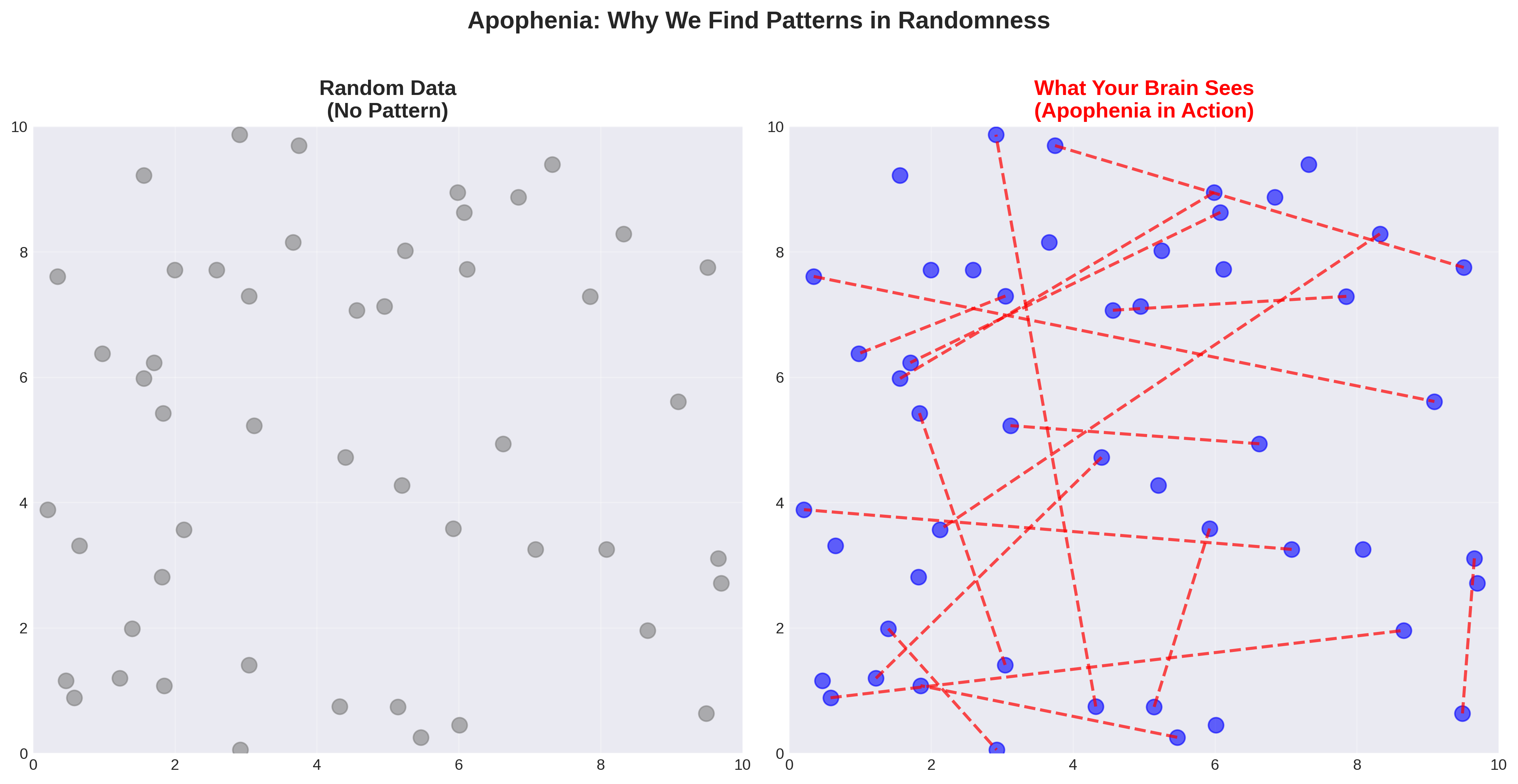
You've seen it a thousand times. You're staring at a bowl of alphabet soup, and suddenly, the letters "C-A-T" seem to jump out at you. You're listening to a song backwards, and you swear you can hear a hidden message. You're looking at the letters in "The United States of America" and realize they can be rearranged to spell "Attaineth its cause, freedom."
Is it a secret code? A divine message? Or is your brain just playing tricks on you?
The answer, according to cognitive science, is a resounding "yes" to the latter. Your brain is a pattern-finding machine, and it's so good at its job that it often finds patterns that aren't actually there. This phenomenon, known as apophenia, is the reason we see faces in clouds, find "messages" in random noise, and, yes, discover anagrams in places where they were never intended to be.
Apophenia: The Engine of Conspiracy
Apophenia is the universal human tendency to seek patterns in random information. It's a byproduct of our evolutionary history; our ancestors who were better at spotting the pattern of a predator in the rustling grass were more likely to survive. But in the modern world, this pattern-detection software often goes into overdrive.
"Apophenia is the propensity to mistakenly detect patterns or connections between unrelated events, objects, or occurrences."
This is the psychological engine that drives conspiracy theories. Apophenia allows someone to take a series of unrelated events—a political speech, a stock market dip, a weird weather pattern—and weave them into a grand, overarching narrative. It's the same mental process that allows a gambler to believe they've found a "pattern" in a roulette wheel's random spins.
And it's the same process that makes us see anagrams everywhere.
The Anagram Delusion
When you're presented with a jumble of letters, your brain's apophenia kicks in. It desperately wants to find order in the chaos. It starts shuffling, rearranging, and testing combinations until it finds a word or phrase that makes sense. This is the very essence of solving an anagram.
But this pattern-finding drive is so strong that it can lead us to believe there's intent and meaning where there is none. Consider these famous examples:
| Original Phrase | Anagram | Perceived Meaning |
|---|---|---|
| Princess Diana | End is a car spin | A premonition of her tragic death |
| The Morse Code | Here come dots | A clever, self-referential description |
| Statue of Liberty | Built to stay free | A patriotic affirmation |
| Astronomer | Moon starer | A poetic job description |
| Dormitory | Dirty room | A relatable truth |
| Eleven plus two | Twelve plus one | Mathematical perfection |
Are these secret messages deliberately hidden by some shadowy organization? Or are they simply the inevitable result of a brain that is hardwired to find patterns, combined with the mathematical probabilities of letter combinations? Cognitive science points squarely to the latter.
Pareidolia: Seeing Faces in the Anagrams
A related phenomenon is pareidolia, the tendency to perceive a specific, often meaningful image in a random or ambiguous visual pattern. It's why we see a "man in the moon" or a face in a piece of toast. A 2022 study in Frontiers in Human Neuroscience found that creative individuals are more likely to experience pareidolia, suggesting a link between pattern recognition and creativity.
When we find a particularly apt anagram, like "astronomer" becoming "moon starer," we are experiencing a linguistic form of pareidolia. Our brain is not just finding a pattern; it's finding a meaningful pattern, one that resonates with our existing knowledge. The anagram feels "right" because it connects to the original phrase in a satisfying way. It's a small, delightful jolt of cognitive closure.
Put your brain's pattern-finding abilities to the test with our word puzzle tools:
Your Brain on Anagrams
So, is the thrill of finding a great anagram a delusion? Not at all. It's a celebration of your brain's incredible power. You are using the same cognitive machinery that allowed your ancestors to survive, that inspires artists to create, and that drives scientists to discover the fundamental patterns of the universe.
The key is to recognize it for what it is. The anagrams you find are not secret codes from the Illuminati. They are a testament to the beautiful, chaotic, and endlessly creative pattern-finding engine that is the human brain.
So go ahead, keep searching for those hidden words. Embrace your inner apopheniac. Your brain is built for it.
Frequently Asked Questions
Apophenia is the tendency to perceive meaningful connections or patterns between unrelated things. It's the psychological phenomenon that makes us see faces in clouds, find 'hidden messages' in random noise, and discover anagrams that seem too perfect to be coincidental. It's a fundamental feature of human cognition, not a flaw.
Your brain evolved to be a pattern-detection machine because it was essential for survival. Ancestors who quickly spotted the pattern of a predator in the grass survived to pass on their genes. This hyperactive pattern recognition sometimes fires in situations where no real pattern exists, leading to apophenia.
Pareidolia is a specific type of apophenia where you perceive familiar images (especially faces) in random stimuli. Classic examples include seeing the 'Man in the Moon,' finding faces in electrical outlets, or spotting religious figures in toast. A 2022 study found that creative individuals are more likely to experience pareidolia.
Yes, apophenia plays a significant role in conspiracy thinking. The same cognitive process that helps us solve puzzles can lead people to connect unrelated events into elaborate narratives. The brain's desire to find meaning and patterns can override critical analysis, especially when events feel random or frightening.
Solving intentional anagrams is a skilled application of pattern recognition. However, when we discover 'meaningful' anagrams in random text or believe certain anagrams contain hidden messages (like 'Princess Diana' = 'End is a car spin'), we're experiencing apophenia—finding significance where there may be none.
Apophenia is linked to creativity, innovation, and scientific discovery. Many breakthroughs come from seeing connections others miss. The key is balancing pattern recognition with critical thinking to distinguish genuine insights from false patterns.
References
- Ness Labs. (2023). The dangers of apophenia: not everything happens for a reason. https://nesslabs.com/apophenia
- Bellemare-Pepin, A., et al. (2022). Processing visual ambiguity in fractal patterns: Pareidolia as a proxy for the perceptual aspect of creativity. Frontiers in Human Neuroscience, 16. https://doi.org/10.3389/fnhum.2022.950855
- Conrad, K. (1958). Die beginnende Schizophrenie. Versuch einer Gestaltanalyse des Wahns. Stuttgart: Thieme.