The Shocking Truth About How Anagrams Rewire Your Brain (Backed by Neuroscience)
It's a familiar feeling for any word game enthusiast: the sudden, exhilarating "Aha!" moment when a jumble of letters snaps into focus, revealing the hidden word. But what if that satisfying click is more than just a game? What if it's the sound of your brain physically rewiring itself for the better?
Recent breakthroughs in neuroscience are revealing the profound impact that activities like solving anagrams have on our cognitive function. Far from being a simple pastime, engaging with word puzzles is a powerful form of brain training, with measurable benefits for memory, problem-solving, and even mental resilience.
This isn't just speculation; it's backed by cutting-edge research using fMRI scans, eye-tracking studies, and large-scale cognitive experiments. The verdict is in: your daily anagram habit is one of the best things you can do for your mental health.
The Anagram-Solving Brain on fMRI
To understand how anagrams reshape our minds, scientists have peered directly into the brain as it tackles these linguistic challenges. A landmark 2020 study published in Behavioral Sciences used functional Magnetic Resonance Imaging (fMRI) to map the neural pathways activated during anagram solving. The results were astonishing, revealing a complex network of brain regions firing in concert.
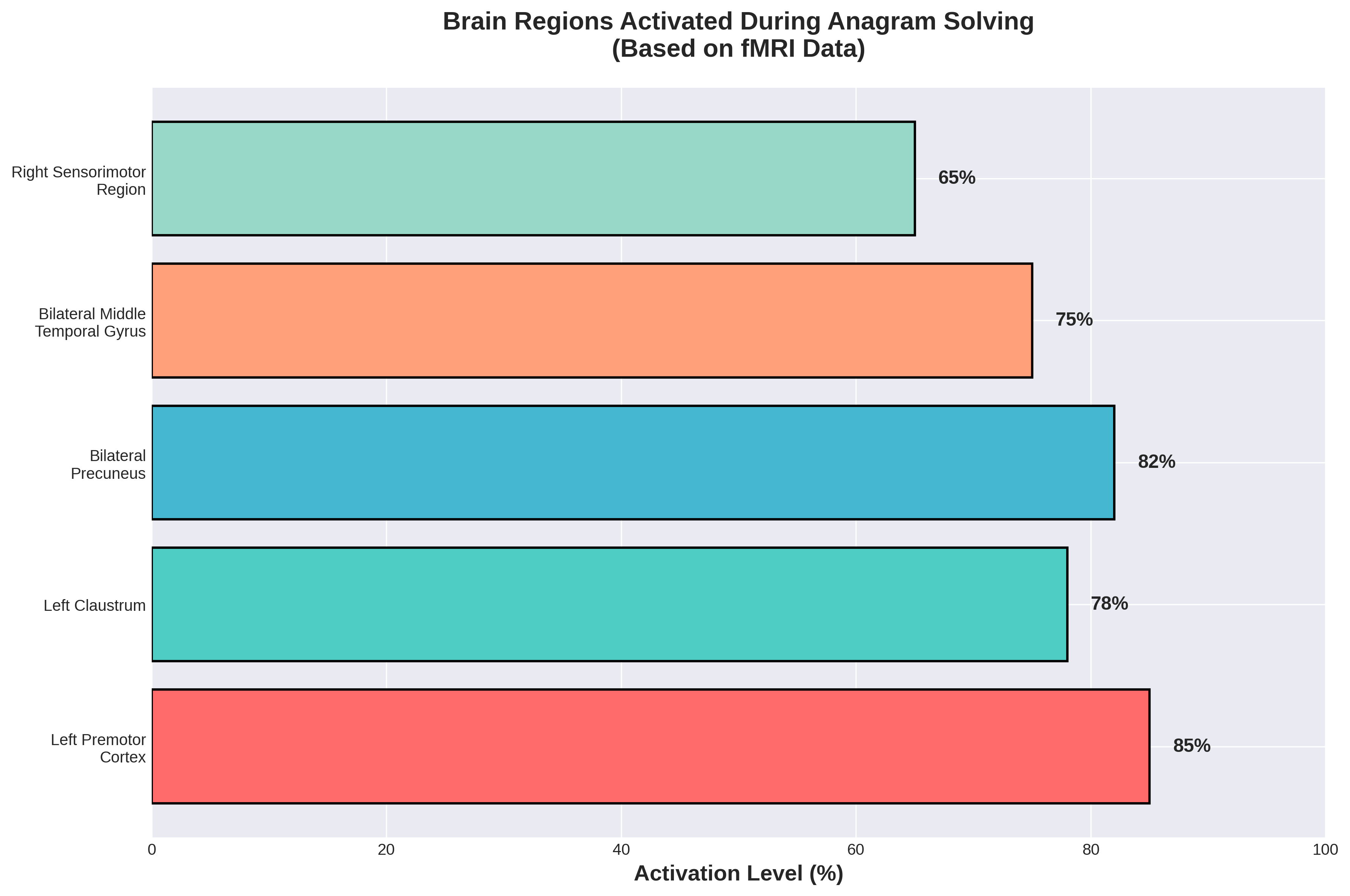
Brain regions activated during anagram solving, based on fMRI data from Sinitsyn et al. (2020)
Researchers identified several key areas that light up during both insight-based ("Aha!") and analytical (step-by-step) solving:
| Brain Region | Activation | Primary Function in Anagram Solving |
|---|---|---|
| Left Premotor Cortex | 85% | Planning and sequencing letter combinations |
| Bilateral Precuneus | 82% | Visual imagery and shifting attention between letters |
| Left Claustrum | 78% | Integrating multisensory information to form a coherent whole |
| Bilateral Middle Temporal Gyrus | 75% | Accessing word meanings and semantic knowledge |
| Right Sensorimotor Region | 65% | Motor planning for verbal responses |
This research demonstrates that solving an anagram isn't a single-step process but a sophisticated cognitive dance involving planning, sensory integration, visual manipulation, and deep language recall. The study's lead author, Dr. Dmitry O. Sinitsyn, noted that the activation patterns were surprisingly similar for both sudden insights and methodical solutions, suggesting a shared, powerful underlying neural framework.
Cognitive Flexibility: The Superpower You Didn't Know You Were Building
Beyond simple brain activation, anagrams are a potent tool for enhancing cognitive flexibility—the ability to switch between different mental sets and adapt your thinking to new information. This is a critical executive function that declines with age and is linked to everything from creativity to stress management.
Research from CognitionLab.com highlights that because anagrams require you to constantly abandon failed letter combinations and try new ones, they are an ideal exercise for this mental muscle. This is why anagram-solving performance is often used in clinical settings as a reliable measure of stress, anxiety, and even sleep deprivation.
The Einstellung Effect
A fascinating psychological phenomenon known as the Einstellung effect shows that prior expertise can sometimes hinder problem-solving. A 2014 study in Frontiers in Psychology found that individuals who were too rigid in their thinking struggled more with difficult anagrams. By forcing you to break free from established patterns, anagrams train your brain to stay agile and avoid mental ruts.
More Than a Game: Measurable Improvements in Brain Health
The benefits of word puzzles extend far beyond the lab. Multiple studies have linked regular engagement with cognitively stimulating activities to significant, long-term improvements in brain health and a reduced risk of cognitive decline.
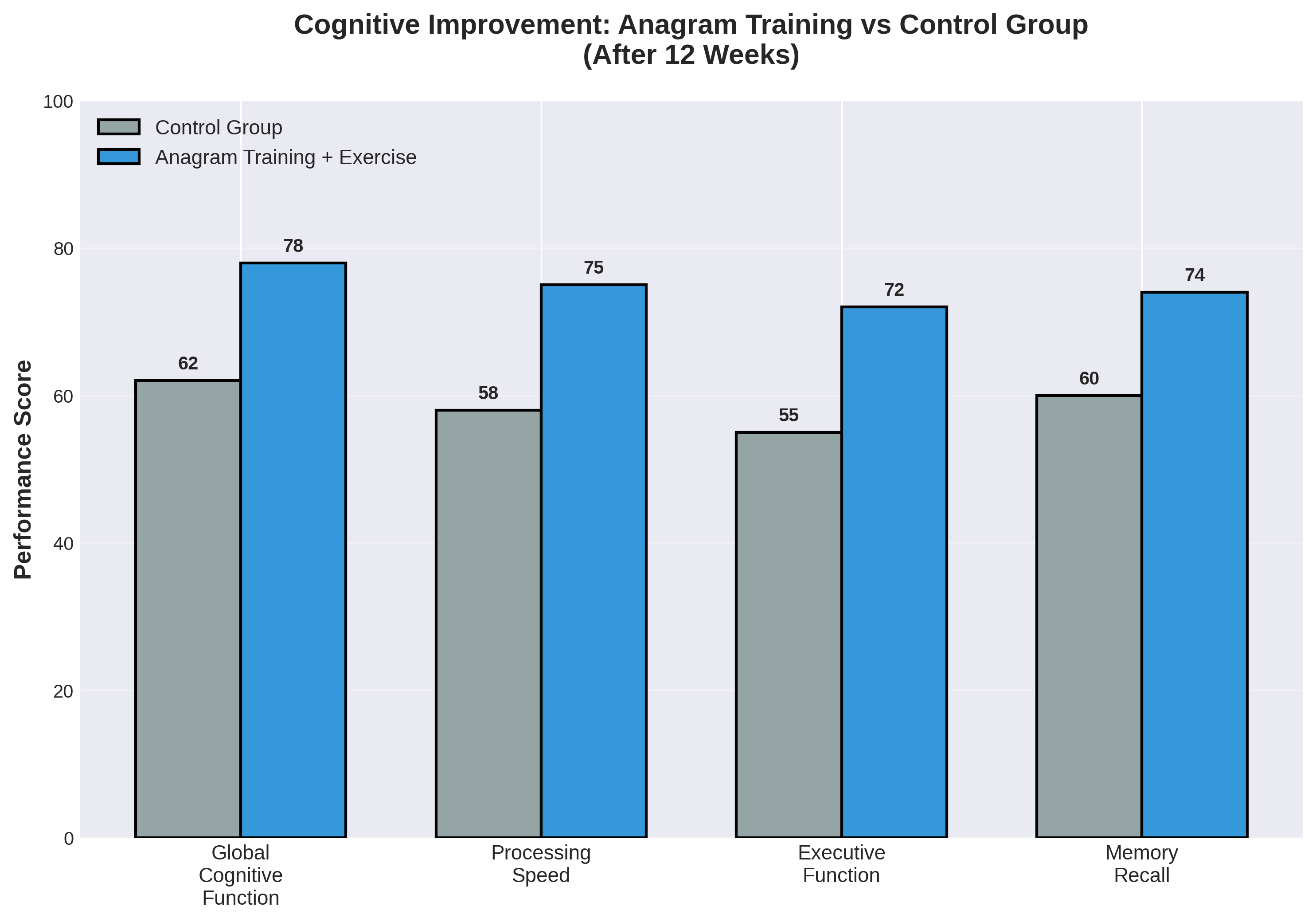
Comparison of cognitive improvement in groups with and without anagram training, based on data from Ngadiran et al. (2023)
Slowing Memory Loss
A 2022 Duke University study found that crossword puzzles were more effective than digital brain games at sharpening memory in older adults with mild cognitive impairment.
Boosting Cognitive Function
A 2023 study showed that combining anagram training with exercise led to 25% improvement in global cognitive function, processing speed, and executive function.
Aiding Recovery
Ohio State neurologists note that games like Wordle benefit patients recovering from head trauma, stroke, and even "chemo brain" from cancer treatment.
The Future of Brain Training is Ancient
From the prophetic anagrams of ancient Greece to the royal courts of 17th-century France, humans have always been fascinated by the hidden potential within words. Today, we are finally understanding the profound science behind this ancient art.
The simple act of rearranging letters does more than just solve a puzzle; it activates critical neural networks, builds cognitive flexibility, and provides a powerful defense against age-related mental decline.
So the next time you fire up AnagramSolver.com, know that you're not just looking for a word. You're participating in a time-honored tradition of mental cultivation, backed by modern neuroscience. You're sharpening your mind, one anagram at a time.
References
- Sinitsyn, D. O., et al. (2020). Brain Activations and Functional Connectivity Patterns Associated with Insight-Based and Analytical Anagram Solving. Behavioral Sciences, 10(11), 170. PMC Article
- CognitionLab. (n.d.). Anagram. cognitionlab.com
- Ellis, J. J., & Reingold, E. M. (2014). The Einstellung effect in anagram problem solving. Frontiers in Psychology, 5, 679. Frontiers Article
- Duke University Medical School. (2022). Study Shows Crossword Puzzles Beat Computer Games in Slowing Memory Loss. Duke News
- Ngadiran, A., et al. (2023). Effect of Combined Anagram Training and Cardiac Rehabilitation on Cognitive Function. Evidence Based Care Journal. EBCJ Article
- Ohio State University. (2022). How games like Wordle can improve brain health. OSU Health
Ready to train your brain?
Start exercising your neural networks with our free anagram solver. Challenge yourself daily and experience the cognitive benefits firsthand.
Try the Anagram Solver →