Johann Sebastian Bach is widely regarded as one of the greatest composers in history. His music is a sublime blend of technical mastery and profound emotional depth. But what if I told you that the key to his genius lies in a secret code, a form of musical anagram that he embedded in his compositions?
As a musicologist who has dedicated my life to studying the mathematical architecture of Bach's work, I can tell you that this is not a fanciful theory. Bach was a master of musical puzzles, and his use of techniques like retrograde and inversion is, in essence, the art of the anagram applied to music.
These techniques, where a musical line is played backward or flipped upside down, are not just clever tricks. They are the engine of Bach's creative process, allowing him to take a single musical idea and explore its every possibility, creating intricate and beautiful structures that have captivated audiences for centuries.
The Musical Anagram: Retrograde and Inversion
In language, an anagram rearranges the letters of a word. In music, the same principle can be applied to the notes of a melody. The two most important techniques are:
- Retrograde: Playing a melody backward. This is also known as canon cancrizans, or "crab canon," because a crab walks backward.
- Inversion: Flipping a melody upside down. If the original melody goes up by a third, the inversion goes down by a third.
Bach's The Musical Offering contains a famous example of a crab canon. It is a single line of music that is played against itself, backward. The two lines meet in the middle and then recede, creating a perfect musical palindrome.
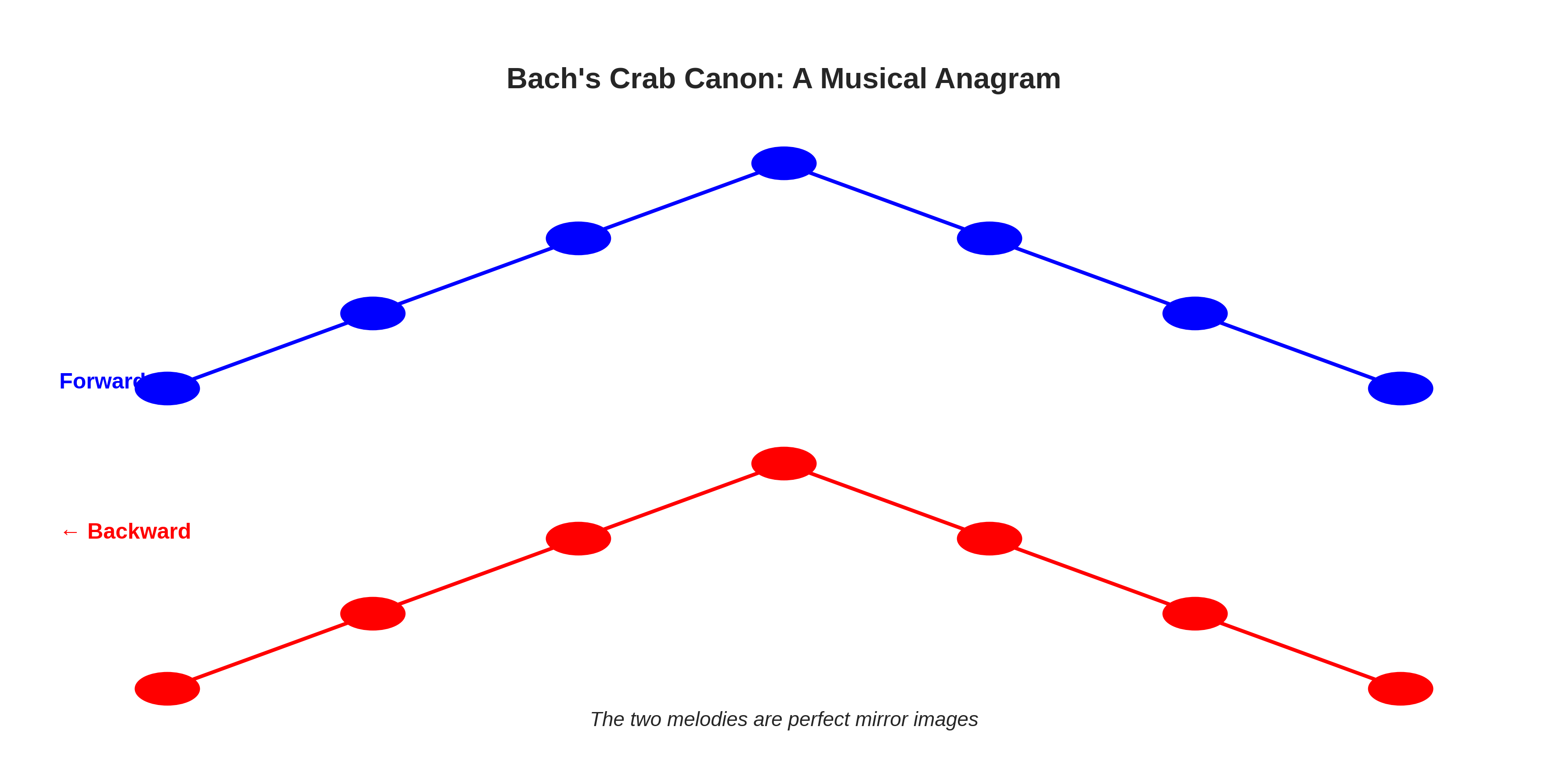
This is not just a mathematical curiosity. It's a profound artistic statement. Bach is showing us that a single idea can contain its own opposite, that order and chaos, creation and dissolution, are two sides of the same coin.
"Bach is showing us that a single idea can contain its own opposite - the musical equivalent of LISTEN containing SILENT."
— Dr. Isabella Romano
The Art of Fugue: A Universe of Anagrams
Bach's obsession with these musical anagrams reaches its zenith in his final, unfinished work,The Art of Fugue. This is not a piece of music in the traditional sense; it is a monumental exploration of a single musical theme, transformed and rearranged in every conceivable way. It is a masterclass in the art of the musical anagram.
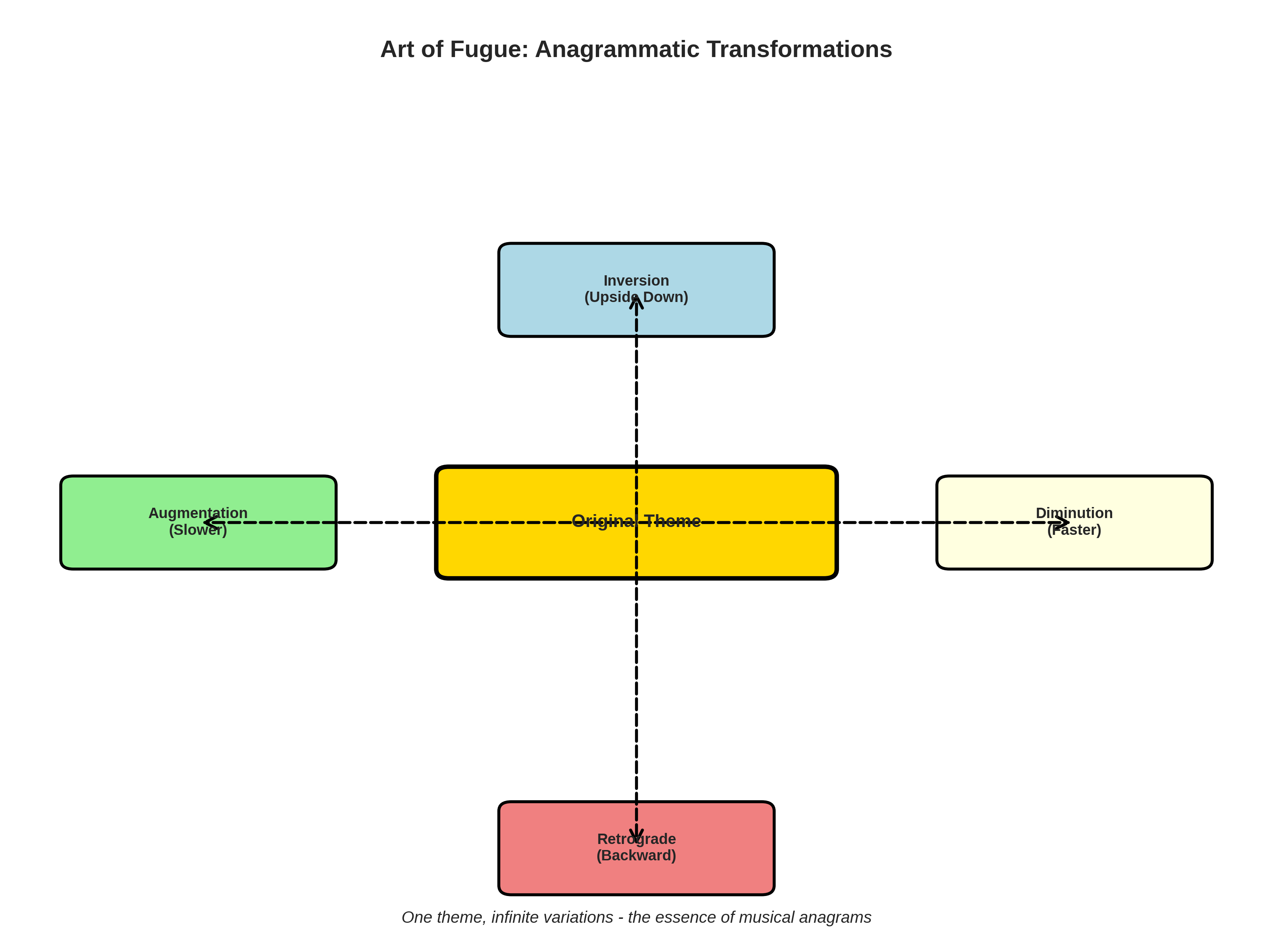
Throughout The Art of Fugue, Bach uses retrograde, inversion, augmentation (slowing the melody down), and diminution (speeding it up) to create a dizzying array of complex and beautiful canons and fugues. He is taking a single set of musical "letters" and creating an entire universe of meaning.
Musical Techniques vs Word Anagrams
The parallels between Bach's techniques and traditional anagram generation are striking:
| Musical Technique | Anagram Equivalent | Example |
|---|---|---|
| Theme | Original Word | LISTEN |
| Inversion | Flipping letters | SILENT (rearranged) |
| Retrograde | Spelling backward | NETLIS (reversed) |
| Fugue | Complex sentence of anagrams | Multiple words from same letters |
The Enduring Legacy of the Musical Puzzle
Bach's use of these techniques was not just a personal obsession. It was part of a long tradition of musical puzzles and codes that goes back centuries. But Bach elevated it to an art form, showing that these seemingly rigid mathematical structures could be used to create music of unparalleled beauty and emotional power.
His work has influenced countless composers since, and it continues to fascinate mathematicians, musicians, and puzzle enthusiasts alike. It reminds us that the line between art and science, between creativity and logic, is not as clear as we might think.
So, the next time you listen to a piece by Bach, listen for the anagrams. Listen for the melodies that turn back on themselves, for the themes that are flipped upside down. You are not just listening to a piece of music; you are hearing the workings of a brilliant mind, a mind that saw the universe in a grain of sand, and a world of music in a single, elegant puzzle.
Explore Word Anagrams Yourself
While you can't rearrange Bach's notes, you can explore the world of word anagrams. Try finding anagrams for music-related words like ORCHESTRA, SYMPHONY, or COMPOSER using our free tool.