Anagrams in the Classroom: A Teacher's Guide to Fun and Effective Learning
Transform vocabulary instruction with engaging anagram activities. Complete lesson plans, grade-level activities, and ESL strategies for educators.
Dr. Sarah Mitchell
Verified ExpertCurriculum Specialist & Literacy Coach
Dr. Sarah Mitchell is a curriculum development specialist with over 18 years of experience in K-12 education. She holds a Ph.D. in Curriculum & Instruction from Columbia University Teachers College and has authored multiple peer-reviewed papers on vocabulary acquisition through game-based learning.
Ph.D. Curriculum & Instruction, Columbia University
National Board Certified Teacher (NBCT)
Former Director of Literacy, NYC Public Schools
Author: 'Word Play: Games That Teach' (Scholastic, 2023)
Key Takeaways for Teachers
- Anagrams build vocabulary, spelling, and critical thinking simultaneously
- Activities can be differentiated for K-12 and ESL learners
- Use subject-specific vocabulary to reinforce content across curriculum
- Free online tools make worksheet creation and interactive lessons easy
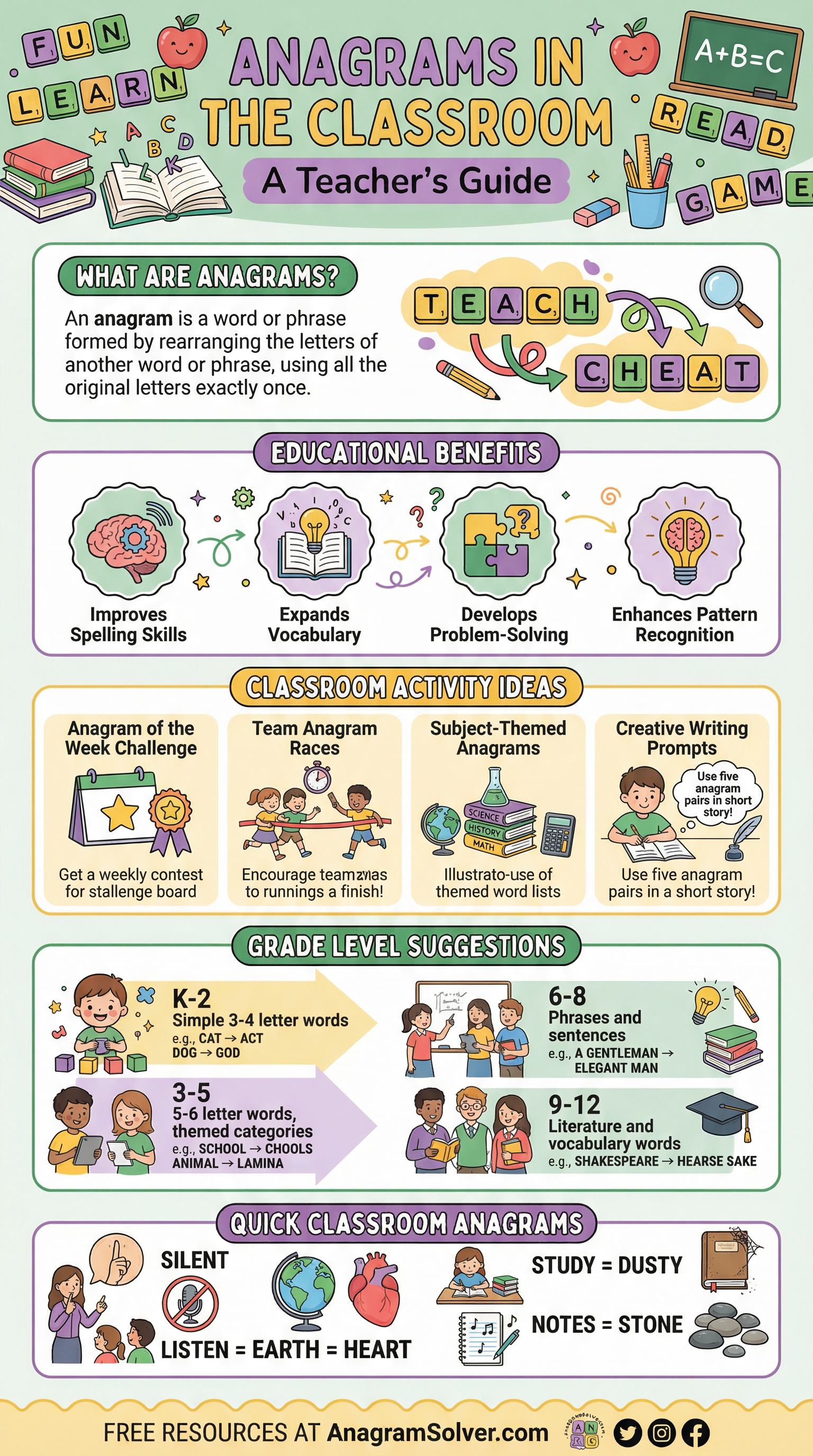
As educators, we're constantly seeking engaging methods to help students learn. Anagrams in the classroom offer a powerful combination of fun and educational value that few other activities can match. This comprehensive guide provides anagram lesson plans for teachers, activities differentiated by grade level, and strategies for teaching vocabulary with word games that students actually enjoy.
The Educational Benefits of Anagrams
Why should you incorporate anagram activities for students into your instruction? Research in cognitive psychology and literacy education supports multiple benefits:
Vocabulary Building
Vocabulary building with anagrams engages students in active word discovery. Rather than passive memorization, students construct understanding through manipulation.
Spelling Improvement
Spelling activities using anagrams force attention to individual letters and their positions, strengthening orthographic memory.
Pattern Recognition
Students develop word pattern recognition skills that transfer to decoding unfamiliar words and understanding word families.
Critical Thinking
Anagrams are puzzles requiring systematic problem-solving, hypothesis testing, and persistence—all 21st-century skills.
Anagram Activities by Grade Level
One of the greatest strengths of anagram activities by grade level is their adaptability. Here's how to differentiate for various developmental stages:
Early Elementary
Focus: 3-4 letter words
Upper Elementary
Focus: 5-6 letter words, themed categories
Middle School
Focus: Phrases and sentences
High School
Focus: Literature and SAT vocabulary
Sample Anagram Lesson Plan (45 minutes)
This ready-to-use anagram lesson plan for teachers can be adapted for grades 3-8. Adjust vocabulary complexity and support levels as needed.
Lesson: Introduction to Anagrams
Hook (5 min)
Start with a fun example on the board. Write 'LISTEN' and challenge students to rearrange it into 'SILENT'.
Direct Instruction (10 min)
Explain what anagrams are and model the problem-solving process. Think aloud as you solve examples.
Guided Practice (10 min)
Work through 3-4 examples as a class, gradually releasing responsibility to students.
Group Activity (15 min)
Divide into teams for an anagram relay race using vocabulary words from current unit.
Independent Practice (10 min)
Students complete differentiated anagram worksheets at their level.
Closure (5 min)
Share discoveries, discuss strategies, and preview tomorrow's 'Anagram of the Day'.
Anagram Games for ESL Students
Anagram games for ESL students are particularly valuable because they provide:
- Visual and kinesthetic learning: Physically manipulating letters aids memory
- Low-anxiety practice: Game format reduces pressure while maintaining rigor
- Letter-sound reinforcement: Repeated exposure to letter patterns builds phonemic awareness
- Vocabulary in context: Discovering words through puzzles creates meaningful connections
For English Language Learners, start with high-frequency sight words and gradually introduce content vocabulary. Pair activities with visual supports—images of the target words help cement meaning alongside spelling.
Quick Classroom Activities
Anagram of the Week
Post a challenging anagram on Monday. First student to solve it earns a small reward. Great for vocabulary from current units.
Team Anagram Races
Divide class into teams. Each team races to unscramble the same list. Encourages collaboration and friendly competition.
Subject-Themed Puzzles
Use vocabulary from science, history, or math units. Reinforces content knowledge while building language skills.
Creative Writing Prompts
Challenge students to write a story incorporating 5 anagram pairs. Combines vocabulary practice with composition skills.
Creating Printable Anagram Worksheets
Need printable anagram worksheets for your classroom? Our free Anagram Solver makes it easy:
- Enter your vocabulary words into the solver
- Note the scrambled versions and valid anagrams
- Create worksheets with scrambled words and blanks for answers
- Differentiate by adjusting word length and providing hints for struggling learners
For interactive whiteboard activities, project the solver and let students take turns entering letters while the class calls out predictions.
Bringing It All Together
Incorporating anagrams in the classroom is a simple yet powerful way to make learning more engaging and effective. From vocabulary building with anagrams to spelling activities using anagrams, the possibilities are endless. The activities naturally differentiate—struggling students find success with shorter words while advanced learners tackle challenging phrases.
Start small with an "Anagram of the Day" routine, then expand to full lessons and cross-curricular integration. Your students will develop stronger vocabularies, better spelling skills, and sharper critical thinking—all while having fun with words.
Create Your Own Classroom Anagrams
Use our free Anagram Solver to generate word puzzles from your vocabulary lists. Perfect for worksheets, whiteboard activities, and learning centers.
Frequently Asked Questions
What age group are anagram activities best suited for?
Anagram activities can be adapted for all ages from kindergarten through high school. For K-2, use simple 3-4 letter words with picture support. Grades 3-5 can handle 5-6 letter words with themed categories. Middle schoolers enjoy phrase anagrams, and high schoolers can tackle literary vocabulary and SAT prep words.
How do I use anagrams with ESL students?
Anagrams are excellent for ESL learners because they provide hands-on letter manipulation that reinforces spelling patterns. Start with high-frequency words, use visual supports, allow partner work, and focus on word families. The physical act of rearranging letters helps cement letter-sound correspondence.
Are there printable anagram worksheets available?
Yes! You can create custom anagram worksheets using our free Anagram Solver tool. Enter your vocabulary words, generate the scrambled versions, and create differentiated worksheets for various skill levels. Many teachers also use our tool during class for interactive whiteboard activities.
How do anagrams improve vocabulary and spelling?
Anagrams require students to analyze letter patterns, recognize word structures, and actively engage with spelling. Research shows that manipulating letters physically or mentally creates stronger memory traces than passive studying. Students also discover new words while solving anagrams, naturally expanding vocabulary.
Can anagrams be used across different subjects?
Absolutely! Use science vocabulary anagrams for biology terms, historical figure names for social studies, mathematical terms for math class, or literary vocabulary for English. Subject-specific anagrams reinforce content knowledge while building language skills simultaneously.
Related Resources
Editorial Standards: This article was written by a certified educator and reviewed by our editorial team for accuracy. We are committed to providing teachers with research-based, practical resources. Last updated: January 2026.