How to Win at Any Word Game: 10 Expert Tips and Strategies
Master Scrabble, Wordle, Words With Friends, and any word puzzle with these proven strategies from tournament players.
Competitive Scrabble Player & Word Game Strategist
Marcus Chen is a competitive Scrabble player with over 15 years of tournament experience. He has placed in the top 50 at three North American Scrabble Championships and coaches aspiring tournament players. Marcus holds a degree in Linguistics from UC Berkeley and has contributed strategy guides to multiple word game publications.
Key Takeaways
- 1.Memorize the 101 two-letter words to unlock parallel play opportunities
- 2.High-value letters (J, Q, X, Z) on bonus squares can score 30+ points alone
- 3.Playing parallel creates multiple words and multiplies your score
- 4.Maintain a balanced rack (3-4 vowels, 3-4 consonants) for more options
- 5.Defense is as important as offense - don't open bonus squares for opponents
Are you tired of losing to your friends in Scrabble, Wordle, or Words With Friends? Do you want to learn the secrets to consistently achieving high scores and dominating the board? You've come to the right place. This guide will provide you with expert tips and word game strategies for beginners and seasoned players alike, helping you understand how to get better at word games and finally claim victory.
1. Master the Two-Letter Words
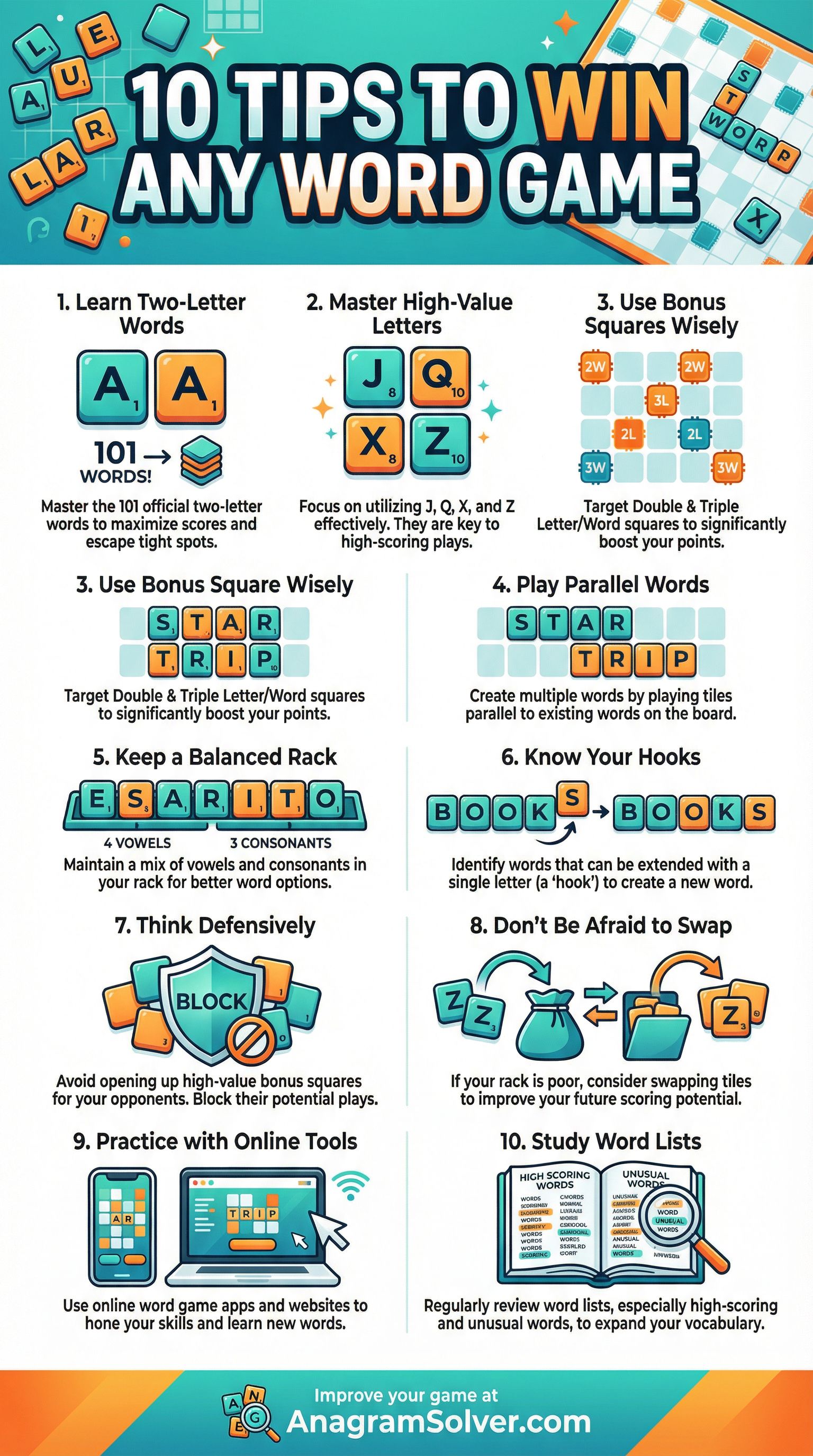
One of the most effective word game hacks that actually work is memorizing the official two-letter word list. In Scrabble, there are 101 two-letter words that can dramatically increase your word game score. These short words are your secret weapon for playing parallel to existing words, allowing you to score points for multiple words in a single turn. This parallel word strategy for Scrabble is a game-changer.
Some essential two-letter words to memorize: QI (vital for Q without U), ZA (slang for pizza),XI (Greek letter), XU (Vietnamese currency), and JO (Scottish sweetheart).
Pro Tip: Check out our complete guide to the 25 best two-letter Scrabble words to master this essential skill.
2. Learn to Love High-Value Letters
Letters like J, Q, X, and Z can feel like a burden, but they are your ticket to high-scoring Scrabble words. Instead of trying to get rid of them, look for opportunities to use them on bonus squares. A well-placed 'Q' on a Triple Letter Score square can be worth 30 points alone. Learning a few key words with these letters is one of the best tips to improve Scrabble skills.
Essential high-value words to know: QUIZ (22 base points), JINX (18 points),ZEPHYR (23 points), QUARTZ (24 points), and JAZZY (33 points).
3. Use Bonus Squares Strategically
Bonus squares (Double/Triple Letter and Double/Triple Word) are the key to massive scores. Before making a move, always scan the board for opportunities to maximize these multipliers. This is one of the most important bonus square strategies for word games. Don't just play a word; play it in the right place.
The ultimate play? Landing a high-value letter on a Triple Letter square while the word covers a Triple Word square. A single word can easily score 100+ points with the right positioning.
4. Play Parallel and Create Hooks
Instead of simply adding to the end of a word, try playing your tiles parallel to a word already on the board. This allows you to form multiple smaller words simultaneously. Also, look for "hooks"—single letters you can add to the beginning or end of a word to form a new one (e.g., adding 'S' to 'WORD'). This is a fundamental strategy for how to win at Scrabble every time.
Common front hooks: C-HEAT, S-PARK, T-RAIN, W-ITCH. Common back hooks: FISH-Y, LUCK-Y, SAND-S, WIND-Y.
5. Maintain a Balanced Rack
An often-overlooked aspect of how to manage letter tiles is maintaining a good balance of vowels and consonants on your rack. A rack full of vowels or consonants can severely limit your options. Aim for a mix of 3-4 vowels and 3-4 consonants. Don't be afraid to swap your tiles if your rack is poor; it's a valid strategic move.
6. Know Your Prefixes and Suffixes
Expanding your word game vocabulary tips should include a focus on common prefixes (like RE-, UN-, IN-) and suffixes (like -ING, -ER, -ED). These can help you extend existing words on the board and score extra points with minimal effort. This is a simple yet powerful way to see more opportunities on the board.
7. Play Defensively
Winning isn't just about scoring high; it's also about preventing your opponent from doing the same. Pay attention to where you're opening up opportunities. Avoid placing high-value letters next to bonus squares that your opponent can easily reach. Good defensive word game strategies can be just as important as offensive ones.
8. Choose the Best Starting Words (for Wordle)
For games like Wordle, your first move is critical. The best starting words for word games like Wordle are those with common, unique letters. Words like 'SALET', 'SOARE', 'RAISE', and 'ADIEU' are popular choices because they help you eliminate or confirm the most frequent letters early on. This is one of the best strategies for Wordle.
Deep Dive: Read our data-driven analysis of the best Wordle starting words for more advanced strategies.
9. Practice with Online Tools
One of the best word game practice tips is to use online tools like AnagramSolver.com. These tools can help you find words you might have missed, study word lists, and practice your skills against a computer. Consistent practice is key to improving your pattern recognition and vocabulary.
Anagram Solver
Find all words from your letters
Wordle Solver
Get help with today's puzzle
Word Unscrambler
Unscramble any jumbled letters
Scrabble Word Finder
Find high-scoring plays
10. Study Word Lists
Take your game to the next level by studying word lists. Focus on high-frequency words, words with high-value letters, and, of course, the two-letter word list. The more words you know, the more options you'll have on the board. This is how you truly beat friends at word games—by out-learning them.
Start Winning Today
By incorporating these ten expert tips into your gameplay, you'll see a dramatic improvement in your performance. Remember, becoming a word game master isn't about memorizing the entire dictionary—it's about understanding strategy, managing your tiles, and knowing when to play offensively or defensively.
Start by mastering the two-letter words, then gradually add high-value words to your vocabulary. Practice regularly with our online tools, and soon you'll be the one your friends are trying to beat. Now, go put these strategies into practice and start winning!
Frequently Asked Questions
What is the best starting word for Wordle?
The best starting words for Wordle are SALET, CRANE, SLATE, and RAISE. These words contain common letters (E, A, R, S, T) in frequently-used positions, helping you eliminate the most possibilities in your first guess.
How can I improve my Scrabble score quickly?
The fastest way to improve your Scrabble score is to memorize the 101 two-letter words, learn high-value letter words (J, Q, X, Z), and focus on playing parallel words to score multiple words in one turn.
What is the parallel word strategy in Scrabble?
The parallel word strategy involves playing your tiles alongside an existing word on the board, creating multiple two-letter words simultaneously. This technique can easily double or triple your score compared to playing perpendicular to existing words.
Should I swap tiles in Scrabble?
Yes, swapping tiles is a valid strategic move when your rack has too many vowels, too many consonants, or duplicate letters that limit your options. A well-timed swap can set you up for a much higher-scoring play on your next turn.
What are hooks in word games?
Hooks are single letters you can add to the beginning or end of existing words to form new words. For example, adding 'S' to 'WORD' makes 'WORDS', or adding 'C' to 'HEAT' makes 'CHEAT'. Knowing common hooks helps you extend plays and score more points.
Related Articles
Editorial Standards
This article was written by Marcus Chen, a competitive Scrabble player with verifiable tournament credentials. All strategies have been tested in competitive play. Our content is reviewed for accuracy by our editorial team. We update our guides regularly to reflect current game rules and strategies.Learn more about our editorial process.