From Ancient Greece to Harry Potter: The 2,500-Year Secret History of Anagrams
What do ancient Greek prophets, 13th-century Jewish mystics, King Louis XIII of France, and Lord Voldemort have in common? They are all part of the rich and surprisingly complex 2,500-year history of the anagram.
This simple word game—rearranging the letters of a word or phrase to produce a new one—is more than just a puzzle. It has been used as a tool for prophecy, a method of divine interpretation, a form of scientific encryption, and a sophisticated literary device that continues to captivate us today.
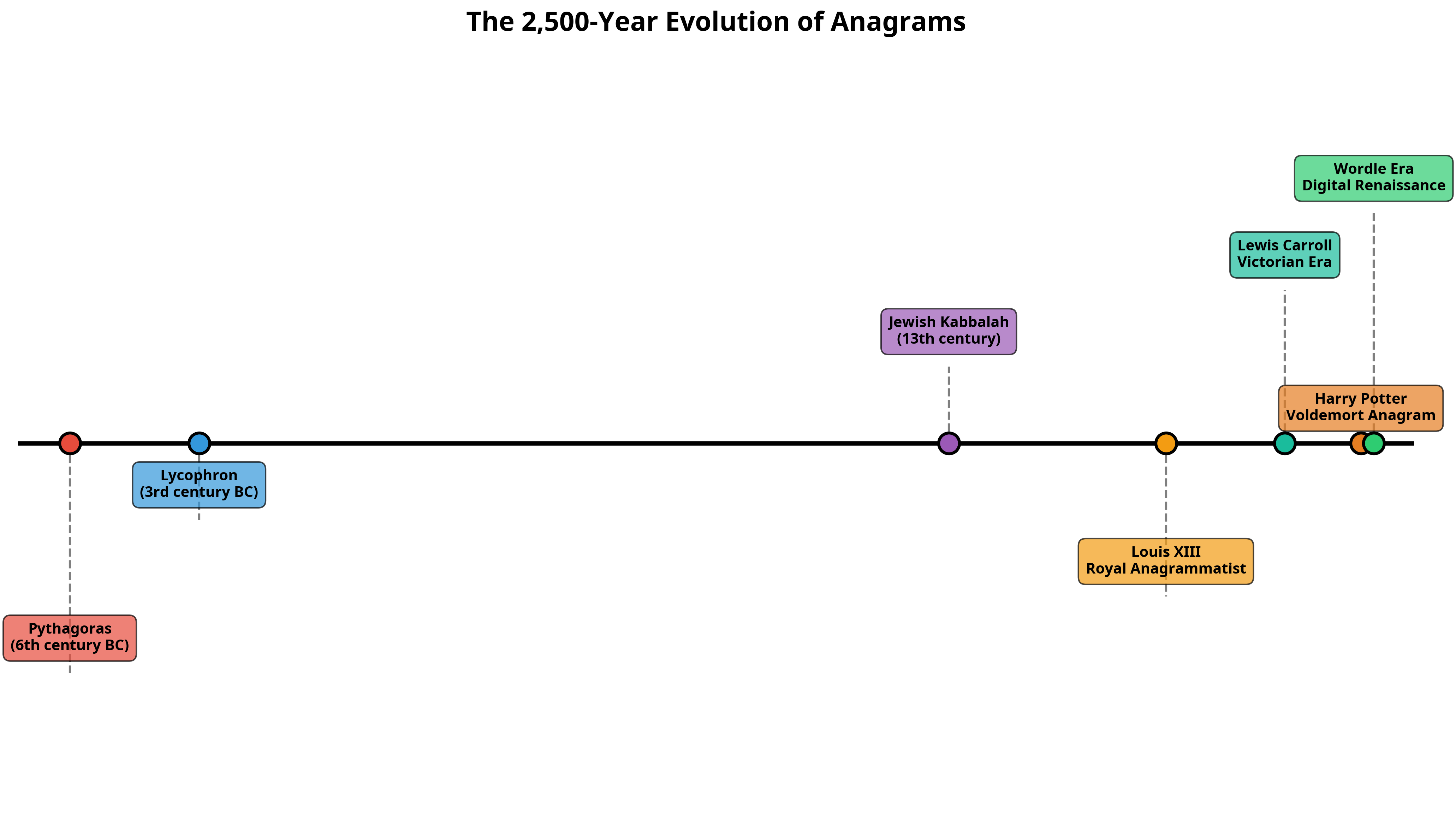
A visual journey through 2,500 years of anagram history, from ancient prophecy to modern puzzles
The Dawn of Anagrams: Prophecy and Philosophy in Ancient Greece
The story of the anagram begins in the ancient world, where it was seen not as a game, but as a key to unlocking the secrets of the universe. While some historians point to the 6th-century BC philosopher Pythagoras as an early user of anagrams for philosophical discovery, the art form was perfected by the Greek poet Lycophron in the 3rd century BC.
Serving in the court of King Ptolemy II Philadelphus in Alexandria, Lycophron was tasked with creating flattering anagrams for the royal family. His most famous creations include:
- PTOLEMAIOS (Ptolemy) → APO MELITOS (made of honey)
- ARSINOE (The Queen) → ION HRAS (Hera's violet)
But anagrams were not merely for flattery. They were instruments of prophecy. According to historical accounts, on the eve of his siege of Tyre, Alexander the Great dreamed of catching a satyr. His advisor, Aristander, saw this as a powerful omen, as the Greek word for satyr could be rearranged to mean "Tyre is yours." The city fell the very next day.
Mysticism and Religion: The Anagram in Sacred Texts
As civilizations evolved, so did the purpose of the anagram. In Roman and early Christian times, it retained its mystical aura. However, it was in Jewish and Christian theological traditions that the anagram found its most profound application.
The Kabbalistic Tradition
During the 13th century, Jewish Kabbalists embraced anagrams as a core part of their mystical practice. Known as temurah (inversion), this method was used to interpret the Hebrew Bible and uncover hidden layers of meaning within the sacred text.
Anagrams in Christianity
In medieval Europe, Christian monks and scholars used anagrams to affirm their faith. One of the most celebrated examples is the anagram of "Ave Maria, gratia plena, Dominus tecum" (Hail Mary, full of grace, the Lord is with thee), which can be rearranged into "Virgo serena, pia, munda et immaculata" (Serene virgin, pious, pure, and immaculate).
The Golden Age: Anagrams as Intellectual Currency
The practice of anagramming reached its cultural zenith in the courts of Renaissance and Baroque Europe. No longer just a religious or mystical tool, the anagram became a symbol of wit, intelligence, and social status.
King Louis XIII of France was so captivated by the art that in 1624, he appointed Thomas Billon as the official "Royal Anagrammatist," whose sole job was to compose anagrams for the court. This role came with a handsome salary of 1,200 livres per year.
The Modern Era: From Parlor Games to Pop Culture
In the Victorian era, anagrams transitioned from aristocratic entertainment to a popular pastime. Lewis Carroll, the author of Alice in Wonderland, was a renowned anagrammatist who famously created "Flit on, cheering angel" from "Florence Nightingale."
Anagrams in Harry Potter
Perhaps no modern example has done more to popularize the anagram than J.K. Rowling's Harry Potter series. The revelation that "TOM MARVOLO RIDDLE" is an anagram of "I AM LORD VOLDEMORT" is one of the most iconic plot twists in literary history.
The Digital Renaissance
Today, anagrams are more accessible than ever. From Wordle to Scrabble apps, digital tools have democratized the art of wordplay. Online anagram solvers can instantly generate thousands of combinations that would have taken medieval scholars years to compute.
References
Try making your own anagrams!
Use our free anagram solver to discover hidden words in any phrase.
Try the Anagram Solver →